The effect of the defect: error coins worth up to 200,000 times more
Error coins are worth up to 200,000 times more
Kostadin Hristov, Notaphilist, chief cashier at UniCredit Bulbank 10 min read
The Bulgarian Mint opened its doors on 28 July 1952. Thirteen years later the first commemorative coins were struck. Almost a decade after that, the first curiosity appeared. In 1975 the Mint struck an issue of commemorative coins for the 10th Olympic Congress, held in Varna in 1973. Face value 10 leva, diameter 40 mm, silver 900/1000, weight 30 g. The mintage was 100,000; half of them have an edge* (see the note at the end of the text – ed.) with the incuse inscription СПОРТЪТ ЗА ЕДИН МИРЕН СВЯТ (Sport for a peaceful world), and the other 50,000 carry the Olympic motto CITIUS, ALTIUS, FORTIUS – faster, higher, stronger.
To the delight of the collecting community, two of the dies shifted during striking, and so the errors were born. The inspectors did not notice the defect, and the curious coins were not destroyed. The first curiosity concerns the words МИРЕН СВЯТ, which after the shift merge into one word: МИРЕНСВЯТ. This small slip now costs no more and no less than 250–300 leva.
The second curiosity concerns the words ЗА ЕДИН, which merge into ЗАЕДИН. It is much rarer than the first and accordingly almost twice as expensive. Otherwise, you can still run to the BNB’s counters today and buy a “Congress” for 15.50 leva.
Curious coins are sought-after and highly valued pieces. Collectors owe them mainly to the Mint’s staff, who let small errors and oversights slip through. Other authors of this pleasant thrill can be found in certain bureaucratic decisions, ministerial decrees and even the personal ambition of long-forgotten party bosses.
The year is 1976. Bulgaria marks the 100th anniversary of a landmark event in its history – the April Uprising. The BNB honours it with an issue of commemorative coins of 1, 2 and 5 leva. The 1-lev coin is copper, the 2-leva coin copper-nickel, the 5-leva coin silver. All have the same mintage: 300,000.
All three denominations carry an incuse edge inscription. On the 1-lev coin it reads БУНТ•БУНТ•НА ОРЪЖИЕ (Revolt, revolt, to arms). The 2-leva coin bears the names of the first towns to rise up: БАТАК, КОПРИВЩИЦА, ПАНАГЮРИЩЕ, КЛИСУРА, ПЕРУЩИЦА (Batak, Koprivshtitsa, Panagyurishte, Klisura, Perushtitsa). The 5-leva coin carries the incuse inscription •БЪЛГАРИЯ•.
The 2-leva coins were the first to reach the BNB’s counters, on 14 April 1976. The obverse shows the face value and a wreath with the inscription ВЕЧНА СЛАВА (Eternal glory), the reverse Borimechkata with the cherry-wood cannon.
At first sight there is nothing alarming or fateful about it. But is that really so?
For the 100th anniversary of the April Uprising, the village of Byala Cherkva was raised to the status of a town. During the uprising, Byala Cherkva sent 103 rebels, who fought in the band of Bacho Kiro and Pop Hariton, crushed by the Turks at the Dryanovo Monastery in May 1876.
It is precisely Byala Cherkva that makes this coin one of the rarest today and sought after by every collector.
Two or three days after the issue, a local party boss of the freshly promoted town noticed with indignation that Byala Cherkva was missing from the edge. Just two more days were enough to stop the entire issue of the two-leva coins. On 19 April the BNB instructed its branches across the country by telex from Sofia to withdraw the coin. Even so, around 120–130 pieces had already reached the public in the first few days.
To cover up the blunder and avoid a fuss, within a month the Mint struck a new mintage of 300,000 “Borimechki”, this time with… a reeded edge. They reached the BNB’s counters as early as 20 June 1976.
120–130 surviving coins with the town names on the edge is not a small number, yet their price today is rather steep and, of course, speculative. Only a month ago a collector offered one for 6,000 leva! He is unlikely to find a buyer soon – but who knows? That is exactly why collectors are mockingly called “the quiet madmen”.
A figure of 3,000 leva is closer to the real price. Many would disagree, since the price is set by demand, and demand is not small. Still, it is not realistic for such a coin to “outdo” a proof of the Santim (our first postage stamp) of 1879. Otherwise, the reeded-edge “Borimechka” is still sold at the BNB today for… 1 lev excluding VAT.
The Mint’s next blunder dates from 1981, when Bulgaria celebrated 1300 years since its founding. For the occasion, over a year or two the BNB issued 20 different commemorative coins, which we will not go into here. The curiosities are found among the ordinary copper-nickel circulation coins.
In honour of Bulgaria’s thirteen centuries, it was decided to release a new issue of copper-nickel circulation coins of 1, 2, 5, 10, 20 and 50 stotinki and 1 lev. On their reverse, around the coat of arms, runs the text ХИЛЯДА И ТРИСТА ГОДИНИ БЪЛГАРИЯ (Thirteen hundred years Bulgaria) instead of the previous НАРОДНА РЕПУБЛИКА БЪЛГАРИЯ (People’s Republic of Bulgaria).
At the start of striking, one of the Mint’s specialists forgot to change the old dies for the 1- and 2-stotinki coins. As a result, about 140 coins of 1 stotinka and 20 coins of 2 stotinki were struck with the old text. Two more cult pieces for collectors were born.
Today you can get a curious 1-stotinka coin for a modest 500–600 leva, whereas for one of the 20 curious 2-stotinki coins you will need at least two thousand!
Warning! Since mid-2008, counterfeits of the 1-stotinka coin have appeared. So be very careful if you come across a “bargain”.
The next curious coin is linked to a highly controversial figure in Bulgarian history: Lyudmila Zhivkova, daughter of the communist leader Todor Zhivkov, who ruled Bulgaria for 33 years. From 1975 Zhivkova chaired the Committee for Art and Culture with the rank of minister; from 1976 she was a member of the Central Committee, from 1979 a member of the Politburo, and a deputy in the VII (1976–1981) and VIII (1981) National Assemblies. As culture minister, Lyudmila Zhivkova organised the celebration of 1300 years of Bulgaria, the hosting of the International Children’s Assembly “Banner of Peace” under the patronage of UNESCO and UNICEF, and the construction of the National Palace of Culture in Sofia.
Lyudmila Zhivkova died in mysterious circumstances on 16 July 1981. The following year the BNB issued two coins of 5 and 20 leva with her portrait, for her 40th birthday and for Bulgaria’s hosting of the Children’s Assembly.
The 20-leva coin is silver, 30 mm in diameter, with a mintage of 10,000. As mentioned, the reverse shows Zhivkova’s portrait, her name, the years 1942–1982 and the text •АСАМБЛЕЯ•ЗНАМЕ НА МИРА• (Assembly “Banner of Peace”). The obverse carries the text НАРОДНА РЕПУБЛИКА БЪЛГАРИЯ, the face value 20 leva and the state coat of arms.
Besides this variant, however, there is another one with an unknown mintage. The differences are small but significant: on the obverse, two emblems appear to the left and right of the number 20 – on the left that of the Children’s Assembly, on the right the emblem of UNICEF (the United Nations Children’s Fund).
It was precisely the unauthorised decision to use the world organisation’s emblem without its permission – and on a coin bearing the portrait of a totalitarian leader’s daughter – that caused the scandal. The “Lyudmila with the emblems” quickly vanished into the BNB’s vaults; only a lucky few got hold of this variant of the twenty-leva coin.
Today this coin is one of the diamonds for collectors; many are willing to part with 3,000, 4,000 or even 5,000 leva to own this rare piece. Nobody, on the other hand, is interested in the ordinary “Lyudmila” today. For 5.50 leva you can acquire a piece of the history of socialism.
In 1986 the 13th FIFA World Cup took place in Mexico. The Bulgarian national team was there. The draw sent us into the opening match against Italy, world champions of the previous tournament. The match ended 1–1, with the equaliser scored by the phenomenal Nasko Sirakov.
Our team had made it through a tough qualifying campaign, best remembered for the 2–0 win over the 1984 European champions France, led by the current UEFA president Michel Platini.
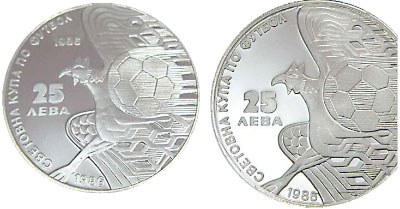
The BNB dedicated three coins to the World Cup in Mexico: a copper-nickel two-leva coin and two silver coins of 25 leva. The silver coins share the same obverse – the coat of arms and the text НАРОДНА РЕПУБЛИКА БЪЛГАРИЯ. The reverse of the first shows a footballer with a ball. The second shows what in recent years has been called the griffin. For the uninitiated: the griffin is a mythical creature, a monstrous bird with an eagle’s head and a lion’s body. The image on the reverse, however, turns out to be simply a running rooster (with a comb, no less) holding a football under its outspread wings. Presumably the author of the design, Marko Blagoev Markov, deeply impressed by the “Lions’” victory over the “Roosters” in Sofia in 1985, approached the composition of rooster and football emotionally.
The official mintage of the coins is 10,000.
As with the previous coin, it unexpectedly turned out that there is a second variant of the running rooster (the terrible griffin), of course with an unknown, small mintage. The difference: the year 1986 is missing above the rooster’s comb.
This missing year above the proud rooster’s comb is now valued at almost three minimum monthly wages.
The Mint’s next big blunder is again connected with football.
In 1996 the BNB brought to its counters a 500-leva coin dedicated to the XVI FIFA World Cup in France, held two years later. The coin is silver, weighs ten grams, has a diameter of 30 mm and a mintage of 60,000. The obverse carries the text РЕПУБЛИКА БЪЛГАРИЯ, the face value 500 leva and the year 1996, surrounded by a composition of roses and ribbon. The reverse shows a stadium with two footballers and below it the text XVI СВЕТОВНО ПЪРВЕНСТВО ПО ФУТБОЛ•1998.
Before the football five-hundred-leva coin was made, however, the Mint struck a very, truly very similar coin for the centenary of the National Academy of Art. Its face value is also 500 leva, the obverse composition is exactly the same (roses with a bow), and the diameter and weight are identical. The only difference is the typeface. The reverse, of course, is completely different – a palette, brushes and the text 100 години НАЦИОНАЛНА ХУДОЖЕСТВЕНА ГАЛЕРИЯ.
What happened when the dies were fitted at the start of striking the football coin remains a mystery, but one thing is certain: once again someone at the Mint fell asleep and forgot to change the obverse die. To the great delight of numismatists, about 30 coins “XVI СВЕТОВНО ПЪРВЕНСТВО ПО ФУТБОЛ•1998” were struck (according to the latest information) with the obverse of the coin “100 years of the National Art Gallery”. This is what numismatists call the curiosity of curiosities; its current price is about 800 leva, with the prospect of much higher values.
Besides the Mint’s big blunders, numismatists also amuse themselves with more modest “defects”. There are coins officially listed in the BNB’s catalogues with a plain edge, of which only a few hundred out of a mintage of tens of thousands actually have a plain edge. The same applies in reverse to coins officially listed with a reeded edge.
This is the case with the 1988 5-leva coin for the 300th anniversary of the Chiprovtsi Uprising, the 1982 10-leva coin for the Spain ’82 World Cup and a few other pieces.
To everyone who has read this piece and whose interest has been sparked, we warmly recommend searching the deep drawers at home for one curiosity or another. Who knows – perhaps, in the raging financial crisis, a single stotinka will bring you an unexpected profit.
* Edge – the narrow side of a coin. The edge can be plain, reeded, or carry incuse or raised lettering or figures.
Translated from Bulgarian by the BulgarianCoins editorial team. Prices in leva, as of 2009.