Ivan Asen II struck the first Bulgarian coins, with Cyrillic inscriptions
6 min read
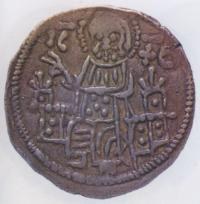
After the founding of the Bulgarian state in 681, money continued to circulate mainly in the form of Byzantine coins. There are a number of reports of coins attributed to Bulgarian rulers before the 13th century, but there is no clear evidence that they are genuine. The prevailing view is therefore that the first coins struck by a Bulgarian tsar date from the 1230s, specifically from 1230, under Tsar Ivan Asen II (1218–1241). The gold coin (hyperpyron, also called perpera and zlatitsa) was struck in honour of the victory at Klokotnitsa over the Despot of Epirus, Theodore Komnenos Doukas, who had proclaimed himself emperor of Thessalonica. It shows Tsar Ivan Asen II standing beside St Demetrius, who is crowning him. It weighs 4.33 g and its gold content is 18 carats. The obverse of the cup-shaped copper coins shows Tsar Ivan Asen II with a short sceptre and St Demetrius with a staff between them; the reverse shows Jesus Christ.
The inscriptions on the coins of Tsar Ivan Asen II used the Slavonic-Bulgarian alphabet – Cyrillic. The coins entered the money circulation of Bulgaria at the time, which was dominated above all by the coins of Byzantium; in the early Middle Ages these served as an international means of payment in the eastern Mediterranean. In the time of the Second Bulgarian State (1185–1396), although numerous coin issues of various Bulgarian rulers were struck, money circulation in the country was carried out mainly with Byzantine coins until the early 1330s. Only under Tsar Ivan Alexander (1331–1371) did Bulgarian coins predominate in circulation. Before his reign, the coins struck by the Bulgarian tsars were not enough to meet the needs of circulation.
While it is almost certain that Tsar Ivan Asen II had his coins struck at the mint of Thessalonica, Tsar Constantine Tikh organised the striking of cup-shaped copper coins in the Bulgarian capital, Tarnovo. They served mainly for internal trade and exchange. They were also widespread in the newly annexed Bulgarian lands in Macedonia, which had a psychological and political effect on the local population – it was now using coins with Cyrillic inscriptions.
Numismatics regards Tsar Mitso Asen (1256–1257), who sat only briefly on the Bulgarian throne, as the second Bulgarian tsar to strike coins. His coins were made between 1257 and 1261, when Mitso (Micho) had already been deposed by Tsar Constantine Asen but still hoped to return to the throne in Tarnovo. The main purpose of this issue was propaganda: as a pretender, he needed to show the other rulers and the population his rights – or rather, his claims – to the throne.
Despot Jacob Svetoslav struck cup-shaped copper coins at the mint of Vidin. Although they share features with those of the Bulgarian tsars in Tarnovo, they differ in that the image of Despot Jacob Svetoslav on the reverse lacks the tsar’s insignia, and in the image of St Demetrius – patron of the Bulgarian royal dynasty – on the obverse. In the last years of his life, this Bulgarian boyar began to lay claim to the royal throne.
Tsar Constantine Tikh Asen (1257–1277) struck six types of cup-shaped copper coins at the mint of Tarnovo.
The mass striking of coins in the Bulgarian capital had economic causes: there was a shortage of Byzantine coins. Constantinople was freed from Latin rule in 1261, and the Empire of Nicaea was unable to issue enough coins to supply the money circulation of neighbouring countries.
Tsar George I Terter (1280–1292) struck copper and silver coins. Archaeologists found five pairs of obverse dies and one reverse die, with which an estimated 150,000 to 200,000 coins were struck. The copper coins show Tsar George I Terter with his son, Tsar Todor Svetoslav, holding a short-shafted cross together, with Jesus Christ on the reverse.
His son, Tsar Todor (Theodore) Svetoslav Terter (1301–1321), also struck silver and copper coins with his portrait. Under him the mint in Tarnovo resumed its work.
One type of silver coin and four types of copper coins were struck under Tsar Michael III Asen (Shishman) (1323–1330). He was elected tsar after the death of the young George Terter II and had previously been governor of the Vidin region. His coins were probably struck at the mint of the capital, Tarnovo, and resemble those of Tsar Todor Svetoslav in their features and images. Later finds of this Bulgarian tsar’s coins in western Bulgaria show some Serbian influence, owing to his kinship with King Stefan Uroš II Milutin (1275–1321): he was married to the king’s daughter, Anna-Neda.
In total, 14 types of copper coins are known from the reign of Tsar Ivan Alexander, some of them in more than one variant.
As mentioned, it was only under Tsar Ivan Alexander that money circulation in Bulgaria was carried out almost entirely with Bulgarian means of payment – that is, there were enough Bulgarian coins in circulation to handle payments in the country. This shows that commodity-money relations in the Bulgarian tsardom of the time were among the most developed in Europe. Under Tsar Ivan Alexander (1331–1371), part of the taxes owed to the treasury was paid in money rather than in kind, as had been the case until then.
Silver and copper coins were issued by Tsar Ivan Sratsimir (1355–1397) in the Tsardom of Vidin. Its capital was Badin (Vidin), and it was in practice an independent state. Vidin, which for about 40 years was the capital of a separate Bulgarian state – the so-called Tsardom of Vidin – had a mint. Later, in the 16th and 17th centuries, the Vidin mint was restored by the Turks and struck a number of issues for the Ottoman Empire. At the end of the 18th and the beginning of the 19th century, the governor of Vidin, Osman Pazvantoğlu, who for about 30 years declared himself a ruler independent of the Turkish sultan with his capital in Vidin, began issuing his own copper coins. These coins were called “pazvanticheta” and were used throughout the Ottoman Empire, but were especially popular in the Bulgarian lands.
A copper coin of Tsar Ivan Shishman (1371–1393) with the image of a lion.
In the second half of the 14th century, copper coins were also issued by the feudal lord of north-eastern Bulgaria, Despot Dobrotitsa. In the last 30 years of the 14th century, Bulgaria was in practice divided into three small states (the Tsardom of Vidin, the Tsardom of Tarnovo and the Despotate of Dobruja). There, coin striking served not only the needs of money circulation but also as a kind of propaganda tool of the rulers towards their subjects.
The other ruler of the Despotate of Dobruja is Ioan Terter. There is no firm evidence whether Despot Dobrotitsa had two sons, Terter and Ivanko, or whether they were one and the same person. A single example of a silver coin survives from his reign, along with two types of copper coins.
Coin striking and money circulation in the time of the Second Bulgarian State were comparatively well developed for their era. This is confirmed by the fact that in the 15th and even the first years of the 16th century, in the Bulgarian lands conquered by the Turks and incorporated into the Ottoman Empire, money circulation was carried out mainly with coins of Bulgarian tsars and feudal lords.
Translated from Bulgarian by the BulgarianCoins editorial team.