Die varieties: the small differences collectors pay more for
Large and small dotted rims, mint marks, different dates and fonts – how to recognise varieties
BulgarianCoins editorial team 3 min read
A die variety is a coin with the same face value, year and design as another, but with a small, constant difference. It is not an error. The mint used different dies – sometimes at different mints, sometimes with corrections to the die. For the collector these are two separate coins, often with different mintages and prices.
The difference between a variety and an error
| Variety | Error | |
|---|---|---|
| Cause | a different die | an accidental defect in striking |
| How many coins | thousands or millions | one or a few |
| Is it repeated | yes, on all coins from that die | no |
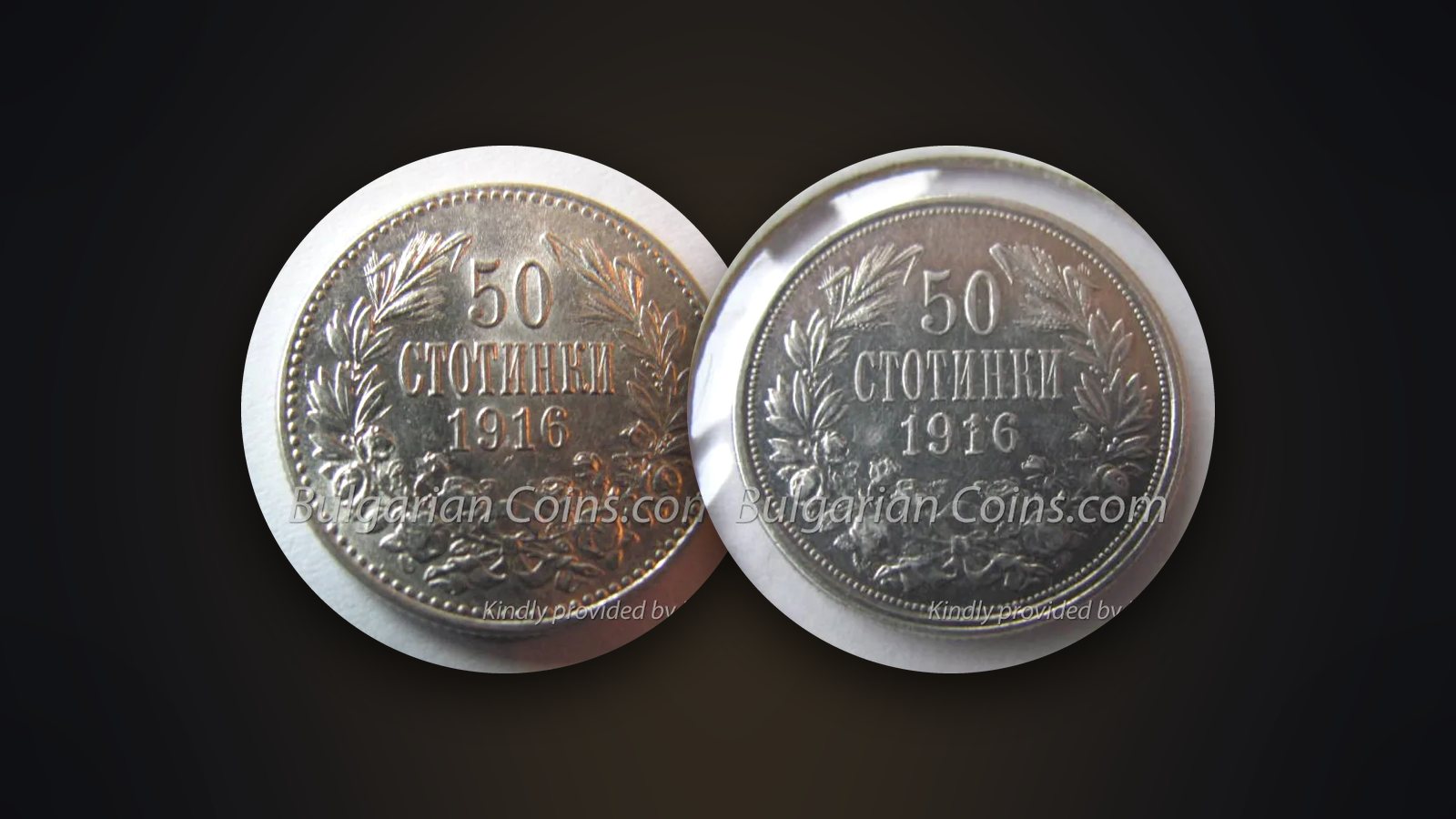
| Example | 50 stotinki 1916 with a small rim | off-centre strike |
More about errors – in Error coins.
The Bulgarian varieties in the catalogue
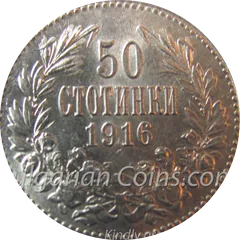
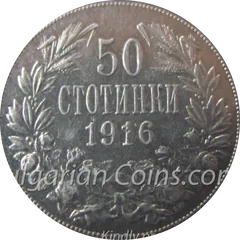
50 stotinki 1916: large and small dotted rim
The dotted rim is the row of dots along the edge of the coin. The 50 stotinki 1916 has two varieties – with a large and with a small dotted rim on the obverse. The difference can be seen with a loupe – in the size and number of the dots.
1 and 2 leva 1925: with and without a thunderbolt
The coins of 1925 were struck at two mints – Brussels and Poissy near Paris. The coins from Poissy have a small thunderbolt next to the date. See 2 leva 1925 with a thunderbolt and 2 leva 1925 without a mark. The mintages are different, and so are the prices. More – in The foreign mints.
1923: two mints
For the aluminium 1 and 2 leva of 1923, listings sometimes state the mint – for example “Heaton”. If you are buying such a coin as a rare variety, ask for clear photos of the details and compare with the catalogue.
The 1912 restrikes
The restrikes of the gold 20 and 100 leva 1912 are a separate case – they were struck 55 years later. See Restrikes and originals.
How to spot a variety
- Use a loupe with 5–10× magnification. See The essential tools.
- Compare with the catalogue. In our catalogue varieties are described as separate coins, with their own photos.
- Look at the details: the dotted rim, the mint mark, the shape of the numerals in the date, the spacing between letters, the details of the coat of arms.
- Compare two coins of the same year side by side.
Why varieties cost more
A variety often has a much smaller mintage than the main coin. Collectors who want a complete collection look for both. Demand for the rarer variety pushes its price up. In addition, many sellers do not know the varieties. So a careful collector can find a rare variety at the price of an ordinary coin.
Varieties of modern coins
With BNB commemorative coins varieties are rare, because they are struck in small quantities. There are, however, differences in quality – proof and “gloss” (BU) from the same issue. These are not die varieties, but they are collected separately. See Proof, proof-like and BU.
In short
Varieties are “the coins within the coin”. They require more knowledge and attention, but make collecting more interesting. If you find a variety that is not described in our catalogue, write to us.